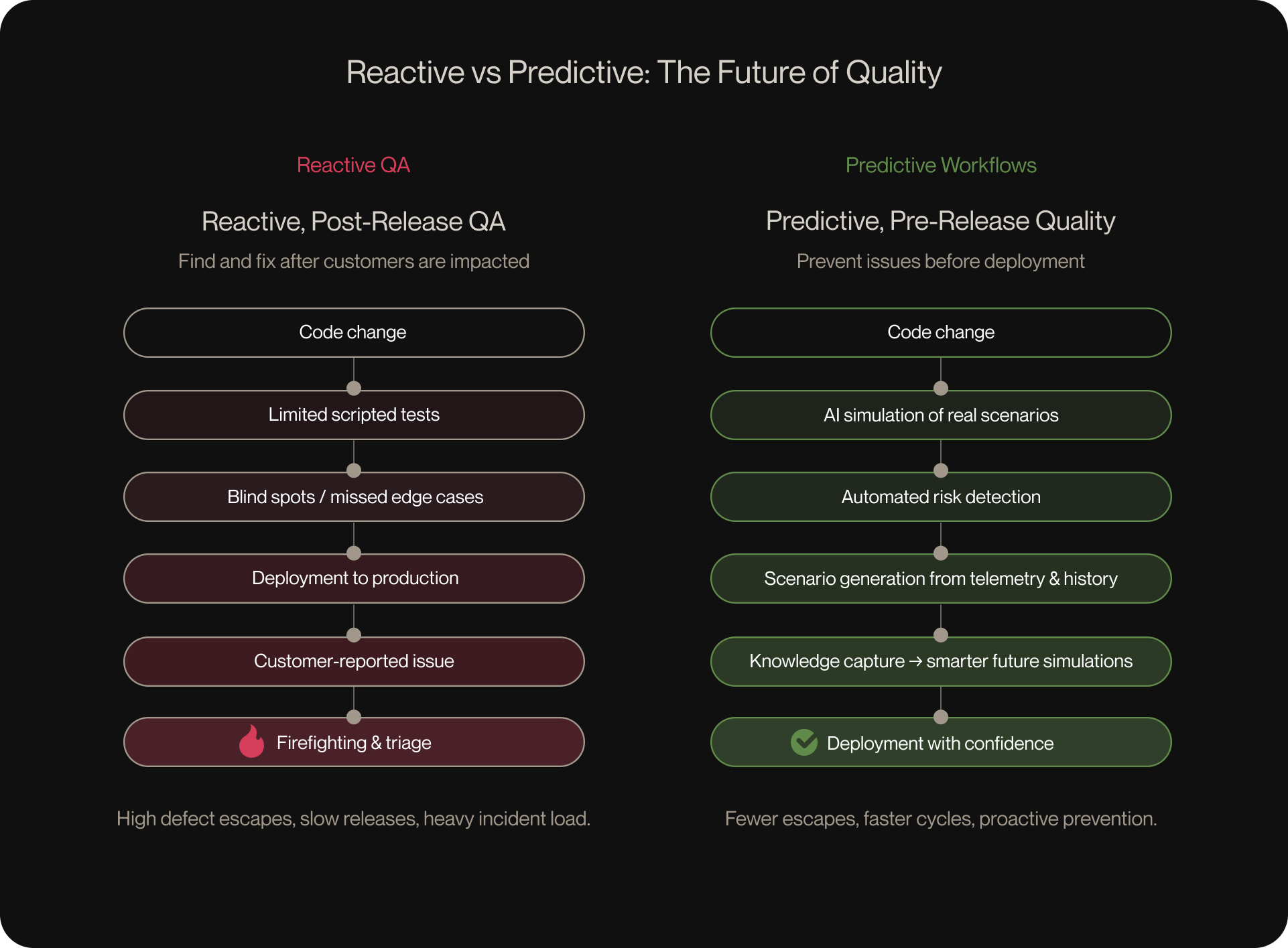
Engineering orgs still assume they must choose: move fast and risk defects, or slow down to ensure software quality.
Modern reality breaks this binary. AI-generation tools multiply code output, microservices create complexity, and distributed teams increase context gaps across growing codebases. What once worked for small teams no longer holds as systems and organizations scale.
As Maria Vinokurskaya, Founding Engineer (AI) at PlayerZero, puts it:
"When you're early, you ship something as fast as you can, see how people react, and iterate. But as the codebase grows, the customer base grows, and more people are working on the product, that approach starts to break down — especially when teams don't have the context of older parts of the system."
The real bottleneck isn't engineering talent or effort. It's fragmented context, institutional knowledge trapped in a few minds, and QA practices that don't scale with modern software complexity.
This guide distills Maria's lessons, alongside real-world patterns from engineering teams operating at scale, into practical strategies for shipping faster without sacrificing software quality.
Why speed breaks down — and why context is the key to restoring it
As software systems grow, making safe changes becomes increasingly complex. Writing code isn't the hard part. It's understanding how a change will behave across distributed systems.
Maria describes this as a new failure mode created by scale. "AI is writing more code, faster. But most teams don't have tools that can efficiently test or even understand that code at the same pace," she notes. "So junk starts hitting production — not because engineers don't care, but because context doesn't scale."
Complex systems make context the new bottleneck
In modern architectures, even small changes ripple across services, data paths, and runtime behavior. To safely modify code, developers must understand upstream and downstream effects — but these mental models are too complex to scale across large teams.
Most teams lack the tools to test and understand system-wide impact at the same pace. The only ones with enough context are senior engineers, who spend increasingly more hours investigating — becoming the de facto source of truth. This is the same expert bottleneck dynamic explored in how to scale engineering teams without scaling their problems, where a team of 50 engineers might have five true experts — and as the team grows to 250, that ratio degrades from 1:9 to 1:49.
Institutional knowledge bottlenecks slow teams at every level
Critical system knowledge accumulates informally. Past outages, architectural trade-offs, and edge cases live in developers' heads, turning everyday work into a series of interruptions.
Because documentation can't capture how a system actually behaves, team leads and senior engineers spend hours answering the same questions: who owns a service, why an API was designed a certain way, or whether a change could trigger a known regression. Over time, this dynamic concentrates risk in a handful of people, increasing system fragility. It's also one of the core reasons legacy application modernization fails — the knowledge required to safely change or replace these systems walked out the door years ago.
Late-stage QA testing hides real issues and stalls delivery
Many organizations rely on QA as the final safety net. But as systems become more distributed, integration tests become harder to write, harder to maintain, and less representative of production behavior. The QA coverage gap is structural: the number of test scenarios teams need grows exponentially while their ability to write and maintain them grows linearly at best.
Issues rooted in missing context or incorrect assumptions surface late, leaving QA teams to catch problems after they've become expensive to fix. Eventually, testing becomes a bottleneck that delays releases and increases costs.
Fragmented tools create slow, manual handoffs
Investigations are rarely straightforward. Data is scattered across tickets, logs, traces, session replays, and repositories, forcing engineers to manually reconstruct what happened before they can fix the problem.
This workflow increases backlog pressure and stretches resolution timelines. The more issues pile up, the less time teams have for new features and preventing future failures. It's the support triage death spiral: unplanned investigation work consumes sprint capacity, which slows delivery, which creates more defects, which creates more investigation work. See how automated root cause analysis breaks this cycle for a detailed look at the math.
Four tactics to break the speed-quality tradeoff
As codebases grow, services multiply, and ownership fragments, code changes faster than teams can understand its full impact. Traditional software quality approaches — manual code reviews, late-stage QA, static documentation — become reactive and incomplete.
Breaking the speed-quality tradeoff requires rethinking where and how confidence is created. Instead of treating quality assurance as a phase, it has to run through the delivery workflow itself.
Strategy 1: Integrate context at every touchpoint to eliminate manual handoffs
Most debugging time isn't spent fixing problems. It's spent understanding them.
Integrating context changes the equation. When code, runtime behavior, and user experience are unified into a single investigative surface, teams no longer need to recreate the past to understand an issue.
This unified view is built on what's known as a context graph. This data structure captures organizational state, relationships, and decision traces across systems like code, tickets, telemetry, and incidents. As a result, teams instantly know what happened, who it affected, which code paths were involved, and how the behavior deviated from expectations.
Why this works:
Full contextual understanding empowers teams and AI platforms to do more independently. Support teams see the full picture — user actions, system responses, and root causes — without engineering input. Because more issues can be resolved directly at the support layer, engineers receive fewer ticket escalations. This shift eliminates reactive triage, freeing up time for innovation.
When escalation is required, engineers receive complete, time-ordered records with session activity, logs, traces, and code paths. With these insights, they can move straight to resolutions without follow-up questions.
Maria notes that these shifts reclaim meaningful capacity: once the investigative work is automated, MTTR compresses naturally. "Without manual back-and-forth and lower-level issues, you're offloading some of the tedious work of testing to automated software."
How it works:
- Unify repositories, telemetry, and ticketing to surface issues with full context
- Train support teams to use contextual debugging for independent triage
- Codify recurring issues into reusable playbooks so teams can resolve independently
At Cyrano Video, unified context eliminated the manual handoffs that slowed issue resolution. With instant access to session data and error traces, support now resolves 40% of issues independently while engineers spend 80% less time debugging. This shift enables both teams to scale more efficiently, supporting broader company growth.
Strategy 2: Maintain a living, continuously updated production world model of your codebase
The hardest knowledge to scale isn't written in code — it's the architectural context, edge case handling, and system intuition that senior engineers carry but rarely have time to share.
A living production world model preserves valuable expertise, making it accessible to every engineer. It's built on context graphs that map service interactions, data flows, and runtime dependencies, enriched with scenarios from past incidents and edge cases. As these graphs accumulate structure, they evolve into active models capable of simulation and prediction — turning past experience into foresight.
Why this works:
As commits, scenarios, and simulations update the model, it builds comprehensive organizational memory. When engineers touch a piece of code, they instantly know:
- What edge cases and past incidents have occurred
- What assumptions shaped earlier architectural decisions
- What downstream impacts and constraints they must respect
As this information accumulates, the model begins to encode dynamics — how decisions unfold, how state changes propagate, how entities interact. Think of it as "organizational physics": patterns that govern a system's behavior:
- How exceptions propagate through approval chains and escalation paths
- What happens when a configuration is changed while a feature flag is enabled
- What the blast radius of deploying to a service looks like given current dependency state
This approach removes delivery friction. As Maria points out, teams don't realize how much time is lost to uncertainty — until that uncertainty is removed. "Understanding unfamiliar code is a lot of work. With a continuously updated model, engineers can navigate the codebase without interrupting senior teammates." For new engineers especially, this is transformative — it's the core principle behind accelerating developer onboarding with AI.
How it works:
World models get more valuable through a feedback loop. Each resolved issue feeds back into the system, where agents analyze patterns and refine predictions. This process unfolds in several stages:
- Early days of deployment: Learning from service dependencies and common failures
- After dozens of issues: Emerging patterns around reliability and interaction effects
- After hundreds of issues: Deep understanding around feature fragility, high-risk code areas, and customer usage patterns
For organizations like Cayuse, embedding this capability into the development lifecycle has consistently reduced dependency on senior engineers. By making institutional knowledge easily accessible, junior team members now solve problems independently, making workflows more efficient and enhancing overall productivity.
Strategy 3: Use code simulations to prevent software defects before they reach customers
Most production defects come from changes that look fine in testing but behave unexpectedly under real-world conditions.
Automated code simulations catch these mismatches early by validating intent — not implementation details — using behavioral scenarios based on code changes, historical issues, and expected user flows.
To achieve this, code simulations perform a line-by-line dry run through your code without spinning up containers, building infrastructure, or writing exhaustive test cases. They replicate the way a senior engineer would trace logic on a whiteboard, but automated and scaled across the codebase. For a detailed look at how this differs from static analysis, see code simulation vs. static analysis.
Why this works:
Rather than asserting on narrow outputs, simulations generate behavioral scenarios based on three inputs:
- What changed in the pull request (code paths, dependencies, and downstream effects)
- How similar changes behaved historically in production
- How users and systems are expected to interact with that surface area in the real world
Maria's team found the value so compelling that they transformed their workflow: "We were so confident in these simulations that our engineers began opening pull requests to trigger them mid-development. This gave them incremental validation instead of batching all testing at the end."
This is the shift from reactive QA to predictive software quality — where defect prevention runs continuously through the delivery lifecycle rather than happening at the end of it. It's also what makes AI-generated test scenarios viable at scale: the codebase model that powers simulations is the same foundation that generates meaningful test coverage.
How it works:
Simulation tests your world model's understanding. If it can't answer key "What if?" questions, it's just a search index.
- Auto-generate scenarios at the PR stage using past incidents and known edge cases
- Investigate failing simulations to check for issues that traditional tests have missed
- Encourage engineers to open PRs earlier to validate intent while fixes are quick
- Run simulations against your codebase to cut test environment and test suite overhead
PlayerZero's Sim-1 model powers this capability — projecting hypothetical changes onto the world model, factoring in proposed code, current configurations, and user behavior, to predict critical outcomes: Will this break something? What's the failure mode? Which customers will be affected?
At Key Data, this early validation delivers measurable gains. By deploying PlayerZero's simulations, they replicate elusive customer-reported issues in minutes rather than weeks. These PR insights give their engineers the confidence to ship changes faster — moving from weekly deployments to multiple per week without sacrificing quality.
Strategy 4: Start with pull requests, prove value quickly, then expand
One of the fastest ways even good engineering initiatives fail is by asking teams to change too much at once.
To prove value, implement at the PR level, where code changes can be validated before they propagate downstream. At this stage, simulations surface risks, context informs reviews, and historical knowledge becomes accessible without disruption. This is essentially the same principle behind moving beyond AI code review to simulation at scale — start where developers already are, then expand outward.
Why this works:
Starting at the PR level works because developers get system-level feedback at the point of decision, before issues escape. Workflows remain intact, and once teams experience fewer regressions, faster reviews, or clearer understanding of changes, resistance to broader adoption drops significantly.
Maria emphasizes that early success builds the trust necessary for broader expansion. "Don't boil the ocean — start where engineers already are and show impact within days. Then, layer in ticketing and observability data."
How it works:
- Deploy on a single, high-impact service or repository first
- Layer in runtime telemetry (logs, traces) to connect code changes to production behavior
- Integrate ticketing and support systems so common issues can be triaged with fewer escalations — for more on the downstream impact, see how automated issue resolution changes the math
- Validate security posture against your existing data handling requirements
When predictive software quality solutions integrate at the PR level, they compound returns. Initial speed gains unlock capacity for prevention, reducing escalations and freeing teams to scale further. The result is adoption that accelerates across services, teams, and eventually the entire delivery lifecycle.
Maria's three metrics that matter
Balancing speed with quality only works if teams measure the right signals.
According to Maria, many organizations default to output metrics — commit counts, deployment frequency, velocity charts. In reality, they should assess whether teams are reducing friction, preserving context, and preventing failure.
MTTR (mean time to resolution)
MTTR measures how quickly teams move from identifying a problem to resolving it. Keeping it low ensures high customer satisfaction and preserves engineering focus for strategic work.
MTTR drops when teams connect repositories, observability, and session data in one diagnostic view. With this centralized intelligence, support teams get the complete picture to resolve issues before escalation, while engineers skip investigation and move directly to solutions. This is the same dynamic that makes automated root cause analysis so impactful — the investigation step collapses from days to minutes.
Time to first commit for new engineers
Time to first commit reveals how much new engineers rely on institutional knowledge. A long delay signals missing context, fragmented system understanding, and lost productivity as new engineers validate changes with senior team members.
To improve it, embed architectural reasoning directly into development workflows. The 7 strategies for accelerating developer onboarding post goes deep on the specific tactics here — when past decisions, edge cases, and system dependencies are discoverable at the point of change, onboarding accelerates without increasing risk.
Defect escape rate
Defect escape rate tracks how often issues reach production or customers. It has an outsized impact on engineering costs: every escaped defect generates support tickets, erodes customer trust, and pulls engineers into emergency fixes.
Escape rate decreases when teams validate intent earlier in the lifecycle. Automated regression testing and PR-level simulation catch behavioral mismatches, regressions, and edge cases before they impact customers — turning quality into a preventative capability that runs continuously.
Reading the downstream signals
As these three metrics improve, teams see secondary effects emerge naturally:
- Engineering interruptions decline as fewer issues require escalation
- Support teams resolve more independently
- Customer ticket volume and severity trend downward as fewer defects reach production
Fast, resilient software delivery is now the expected baseline
When teams have the right context at the right time, speed and quality move together.
As Maria puts it:
"Most teams don't struggle because they can't fix issues. They struggle because they don't have the context to prevent them. Once you give teams that context early, speed and quality stop being a tradeoff."
This shift — from reactive fixing to proactive understanding — is what defines production engineering as a discipline. It's not about any single tool or integration. It's about building a system where knowledge about how your software actually behaves is always accessible, always current, and always working for your team rather than sitting in someone's head.
Book a demo to see how PlayerZero can help your engineering org ship faster with more confidence.
See also:
- Your Engineers Aren't Shipping — They're Triaging
- The QA Coverage Gap: Why Engineering Teams Can't Test Fast Enough
- Legacy Application Modernization Isn't a Tech Problem — It's a Knowledge Crisis
- Beyond AI Code Review: Why You Need Code Simulation at Scale
- 7 Strategies for Accelerating Developer Onboarding with AI
- How to Scale Engineering Teams Without Scaling Their Problems
- What is Production Engineering?
- Code Simulation vs. Static Analysis
- What is Predictive Software Quality?